Your Own Knit Pumpkin Patch — Free Knit Pumpkin Pattern
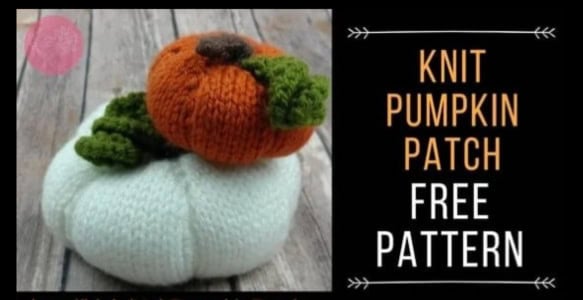
Build your own handmade pumpkin patch with this beginner-friendly knit pattern! Create four sizes (XS through L) using double-pointed needles and Red Heart Super Saver yarn. Perfect for fall decor, Thanksgiving table displays, and gifts that last for years.
⚡ Quick Answer
All you need: Red Heart Super Saver yarn (worsted weight), size 8 (5mm) double-pointed needles, fiberfill, and a tapestry needle. Pick one of four sizes and knit top-down, starting with the vine and stem. Finished pumpkins range from 2″ to 5″ tall — knit them all for a cozy autumn display.
Hey, BiCrafty Bestie 💛
There's something magical about a handmade pumpkin patch. Maybe it's the ritual of casting on the vine, watching it come together round by round, or the satisfaction of stuffing it and pulling those ridges tight. Or maybe it's knowing you're making something no one else has — something uniquely yours. Whatever it is, I love creating these little autumn treasures, and I think you will too. They're the kind of make-along project that feels meditative and rewarding all at once.
What You Will Love About This Knit Pumpkin Pattern 🎃
✅ DPNs Made Approachable — If you've been nervous about double-pointed needles, this is your perfect first project. The pumpkin is small and forgiving, and you'll feel confident with DPNs by the time you bind off.
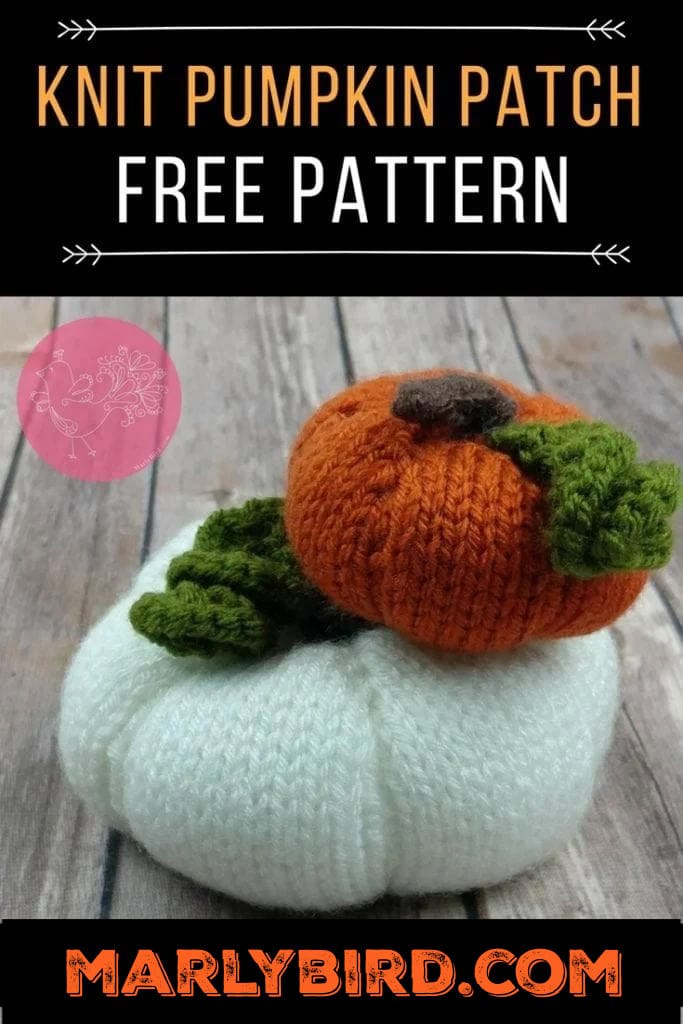
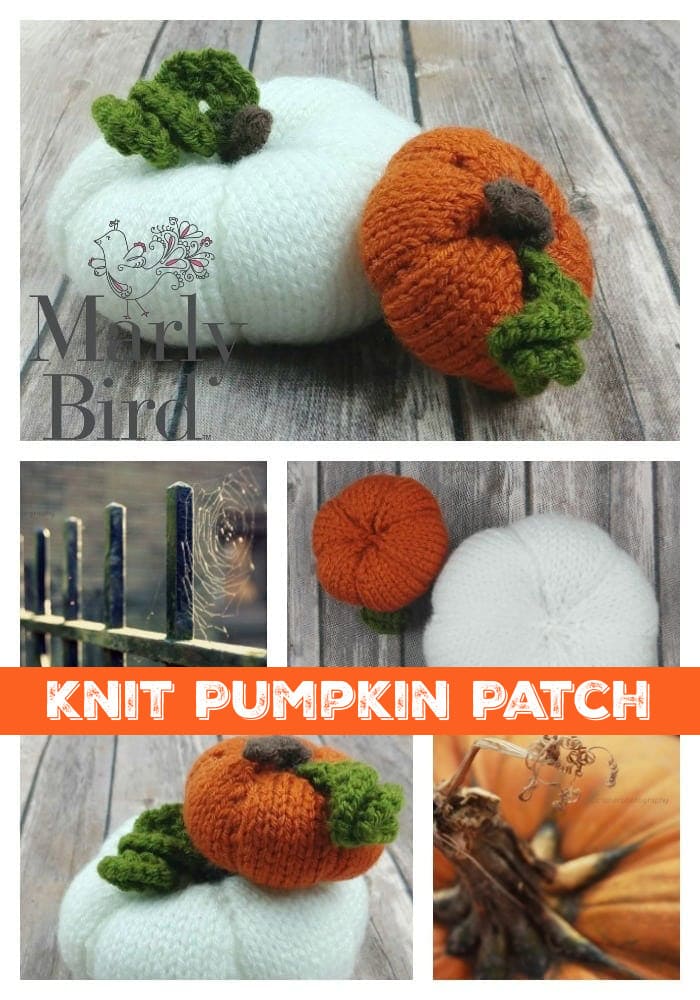
✅ Four Sizes for a Whole Patchwork — Knit XS, S, M, and L in different yarn colors (white gourds, classic orange pumpkins, maybe even a pale green squash?) to create a whole display that tells a story.
✅ Red Heart Super Saver — Affordable & Accessible — This yarn is widely available at every craft store and online, and it holds its shape beautifully once stuffed. Perfect for a beginner or someone testing the idea before committing to higher-end yarn.
✅ Fall & Thanksgiving Decor You'll Treasure for Years — Handmade pumpkins won't fade, don't take up shelf space year-round (they store flat), and add that handcrafted warmth to your home every autumn.
✅ BiCrafty Love — If you crochet instead, check out our Rockford Mosaic Crochet Pumpkins — same seasonal concept, stunning mosaic stitch. Why choose when you can make both?
Is This Knit Pumpkin Pattern Right for You?
✅ This pattern is for you if:
- You're a beginner or adventurous beginner ready to try DPNs
- You want a cozy, quick project (2–4 hours per pumpkin)
- You love autumn, seasonal decor, or making handmade gifts
- You're comfortable with increases, decreases, and basic shaping
❌ This might not be the fit if:
- You've never used DPNs and the idea feels overwhelming (but honestly… try it anyway 💛)
- You prefer large, drape-y garments over structured toys
- You want a pattern that works year-round (though I'd argue pumpkins are timeless!)
Quick Pattern Overview 🧶📏
🧶 Craft: Knitting (DPNs — double-pointed needles)
📏 Sizes: XS, S, M, L — approximate finished widths (stuffed): XS ~3.4″ | S ~4.2″ | M ~5.1″ | L ~5.9″ (calculated from gauge; actual size varies with stuffing)
🎯 Skill Level: Adventurous Beginner (your first DPN project? This is it.)
🧵 Yarn: Red Heart Super Saver, worsted weight (CYCA #4)
🪡 Needles: Size 8 (5mm) double-pointed needles, set of 4
📐 Gauge: 18 sts and 20 rows = 4″ in stockinette stitch
🌸 Construction: Top-down, worked in the round on DPNs
⏱️ Time: 2–4 hours per pumpkin
💚 Best For: Fall home decor, Thanksgiving table arrangements, pumpkin patch displays, gifts, stash busting
Learning to Knit on Double Pointed Needles 🪡
Double-pointed needles (DPNs) might look intimidating if you've never used them — four needles juggling stitches, a risk of dropped stitches, the whole thing seems precarious. But here's the secret: DPNs are actually easier than you think for small projects, and a pumpkin is the absolute perfect size to build your confidence. The pumpkin is small enough that you'll never feel like you're fighting the needles, but complex enough that you'll learn real skills you can carry forward.
The basic idea: you distribute your stitches across three needles and knit with the fourth. It's like a tiny carousel of yarn. Once you establish a rhythm — which happens after maybe two rounds — the needles become an extension of your hands. And because pumpkins are worked in stockinette stitch (just knit rounds), there's no complicated stitch pattern to distract you. You can focus entirely on mastering the motion.
By the time you finish your first pumpkin, you won't be nervous about DPNs anymore. You'll be planning a whole project wardrobe. 💛
Yarn & Materials 🧶
Yarn: Red Heart Super Saver (worsted weight, CYCA #4) — you'll need:
- White (MC — main color)
- Carrot / Tangerine (CA — pumpkin body)
- Medium Thyme / Green (CB — vine)
- Coffee / Brown (CC — stem)
Only a few yards of each color are needed — this is a perfect stash project.
Also needed:
- Size 8 (5mm) double-pointed needles, set of 4
- Tapestry needle (for weaving ends and creating ridges)
- Fiberfill or polyester stuffing (enough to stuff your chosen size)
Yarn Substitutions
Don't have Red Heart Super Saver? These worsted-weight, affordable alternatives will give you the same great results:
Lion Brand Vanna's Choice — Worsted acrylic, 180 yds/100g. This is THE worsted substitute for Super Saver — same feel, excellent stitch definition, widely available at any big-box craft store. Perfect for stuffed items because it holds its shape.
Patons Classic Wool Worsted — 100% wool, 209 yds/100g. A warm, durable option if you want natural fiber and don't mind hand-washing. Wool takes stuffing beautifully and won't flatten over time like some acrylics can.
Lily Sugar ‘n Cream — 100% cotton, 120 yds/50g (worsted weight). For a summery pumpkin variation or if you love cotton's crisp stitch definition. Just be aware you'll need more yardage per color because of the shorter yardage-per-weight ratio.
Bernat Blanket / Bernat Softee Chunky — Chunky weight, but if you drop down to size 9 or 10 needles, these fluffy yarns create plump, squishy pumpkins. Fair warning: the stuffing will be harder to see through the thick yarn, and the gauge math changes.
Stash tip: Any worsted-weight yarn in your stash will work as long as it's not extremely fuzzy (angora, mohair) and you don't mind a different stitch texture. Gauge matters most for size — if your gauge is off, your pumpkin will be slightly different dimensions, but the technique is the same.
Your Own Knit Pumpkin Patch || Pattern Details
Skill Level
Adventurous Beginner. You should be comfortable with: casting on, knit stitch, purl stitch, increases (kfb), decreases (ssk, k2tog), and working in the round on DPNs. The pumpkin itself is straightforward stockinette in the round — the complexity is learning to manage four needles and maintain even tension. This is genuinely a perfect first DPN project.
Finished Measurements
XS: Approximately 2″ tall × 1.5″ wide
S: Approximately 2.5″ tall × 2″ wide
M: Approximately 3.5″ tall × 3″ wide
L: Approximately 5″ tall × 4″ wide
Gauge
18 stitches and 20 rows = 4 inches (10 cm) in stockinette stitch, worked in the round on size 8 (5mm) needles. Gauge matters for size — if you knit looser, your pumpkin will be larger; if you knit tighter, it will be smaller. Swatch if you want precise dimensions, or just cast on and enjoy the process.
Materials
Yarn: Red Heart Super Saver (or substitute worsted-weight yarn of your choice)
— White (MC)
— Carrot or Tangerine (CA)
— Medium Thyme or Green (CB)
— Coffee or Brown (CC)
Needles: Size 8 (5mm) double-pointed needles, set of 4
Notions: Tapestry needle, fiberfill stuffing
Abbreviations
- RS — right side
- WS — wrong side
- CO — cast on
- St(s) — stitch(es)
- KFBF — knit front, back, and front (creates 3 stitches from 1)
- rnd(s) — round(s)
- kfb — knit front and back (creates 2 stitches from 1)
- k — knit
- p — purl
- M1 — make one increase
- ssk — slip, slip, knit (decrease)
- k2tog — knit 2 together (decrease)
- p2tog — purl 2 together (decrease)
- rep — repeat
Special Stitches
Stockinette Stitch (St st) in the round: Knit every round. When you knit every round on DPNs, you create smooth Vs on the right side — that's stockinette.
I-cord (for the stem): An I-cord is a thin, tube-like cord. To work it: cast on 3 stitches on two needles. Knit 3 stitches. Slide the stitches to the other end of the needle (don't turn), pull the yarn tight, and knit again. Repeat until the cord reaches your desired length. The tension of pulling the yarn creates the tube.
Notes
Pumpkins are worked top-down, starting with the vine and stem, then moving into the body where you'll increase to shape the pumpkin and decrease to close it. The stitch pattern uses purl stitches strategically placed to create ridges on the outside of the pumpkin — these ridges are what give the pumpkin its characteristic look and help it hold its shape.
Your Own Knit Pumpkin Patch || Pattern Instructions
Pumpkin Vine
With CB and only two needles, CO 10 (13, 15, 17) sts.
Row 1: KFBF in each stitch — 30 (39, 45, 51) stitches. This will create 3 stitches in each stitch.
Bind off as if to purl all stitches.
Pumpkin Stem
With CC, and only two needles CO 3 sts. Work an i-cord until it measures approx. 1″ [2.54 cm]. (New to i-cord? Read Marly's tutorial or watch the video on YouTube. Love making i-cord? An i-cord maker speeds up the stem dramatically!)
Next rnd: kfb in each stitch (6 sts.)
Divide the stitches between 3 needles.
Body of Pumpkin
Change to your chosen MC or CA. The color names in this pattern are just a guide — you decide which yarn is your main pumpkin color (MC) and which is your contrast (CA). Any color combination works!
Begin Increases
Rnd 1: Knit — 6 stitches.
Rnd 2: Kfb each stitch. (12 sts)
Rnd 3: *K1, p1; rep from * around — 12 stitches.
Rnd 4: *M1, knit to the purl, M1, p1; rep from * around. (12 sts increased per repeat)
Rnd 5: Work the stitches as presented.
XS (3 repeats): 24 → 36 → 48 stitches — stop when you have 7 knits between each purl
S (4 repeats): 24 → 36 → 48 → 60 stitches — stop at 9 knits
M (5 repeats): 24 → 36 → 48 → 60 → 72 stitches — stop at 11 knits
L (6 repeats): 24 → 36 → 48 → 60 → 72 → 84 stitches — stop at 13 knits
Repeat rnds 4 and 5 until there are 7 (9, 11, 13) knits between the purls.
Work evenly in pattern for 11 (13, 17, 21) rnds — 48 (60, 72, 84) stitches. (No new increases — just work the stitches as they appear, maintaining the knit/purl columns.)
XS: 48 → 36 → 24 stitches (2 repeats)
S: 60 → 48 → 36 → 24 stitches (3 repeats)
M: 72 → 60 → 48 → 36 → 24 stitches (4 repeats)
L: 84 → 72 → 60 → 48 → 36 → 24 stitches (5 repeats)
Begin Decreases
Rnd 1: *Ssk, knit to 2 sts before the purl, k2tog, p1; rep from * around. (12 sts decreased per repeat)
Rnd 2: Work the stitches as presented.
Repeat rnds 1 and 2 until there are 24 sts.
Next Rnd: *Ssk, P2tog; rep from * around — 12 stitches.
Last Rnd: *K1, P1; rep from * around — 12 stitches.
Cut the yarn leaving a 30″ or longer tail. Using a tapestry needle, thread the tail through the remaining stitches on the needle and off.
Pumpkin Ridges (The Signature Technique)
This is where your pumpkin goes from “cute knit ball” to “realistic pumpkin.” Stuff the pumpkin fully with fiberfill first — pack it tightly so the pumpkin holds its shape and is nice and plump.
Pull the yarn tail tight like a drawstring and push the tapestry needle through the center of the pumpkin back to the top near the stem.
Insert the tapestry needle back into the bottom of the pumpkin and back up through the center of the pumpkin, pulling the thread tight and following along each purl ridge on the outside. The needle creates indented lines that mirror the purl stitches on the inside.
Repeat for each purl ridge.
Weave in ends securely so they don't escape when the pumpkin is handled.
Finishing & Care 🧡
Once your pumpkins are stuffed, ridged, and the ends are woven in, they're ready to display. Handmade knit pumpkins are surprisingly durable — they won't fade, and they look better with age. If you need to clean them, a gentle lint-roller pass removes dust without disturbing the yarn. Store them gently in a basket or box over the off-season (they flatten nicely for storage), and they'll be ready to brighten your autumn display year after year.
More Free Fall Knit & Crochet Patterns 🍂
- The Bashful Hat: A Free Knit Lace Slouchy Pattern You'll Reach For Every Season
- Rockford Mosaic Crochet Pumpkins — BiCrafty love: same pumpkin concept, stunning mosaic stitch for crocheters
- Sycamore Ruana: Free Knit Ruana Pattern With Lace & Cables
- 10 Free Halloween Patterns
Frequently Asked Questions
What yarn do I need for the knit pumpkins?
You'll need Red Heart Super Saver yarn in four colors: White (MC), Carrot (CA), Medium Thyme (CB), and Coffee (CC). These colors give you the classic autumn pumpkin-and-gourd look, but you can absolutely swap them for your own color palette. The yarn specs are worsted weight (CYCA #4), and only a few yards of each color are needed — this is a perfect stash project.
Can you tell me what size needles to use for this project?
The pattern calls for a set of 4 double-pointed needles in size 8 (5mm). This size matches the gauge in the pattern (18 sts = 4″), so your finished pumpkins will be the correct dimensions. If you use different needles, you may need to adjust your expectations for size.
I'm a beginner, is this pattern going to be too hard?
No! This pattern is rated for beginners, and it's genuinely a perfect first DPN project. You'll start with the vine and stem (working flat on two needles), then move into the body of the pumpkin using basic increases and decreases. By the time you're halfway through the first pumpkin, the rhythm will feel natural, and you'll have real DPN skills under your belt. This is a “learn by doing” pattern — by the end, you've got this.
How do I get the pumpkin to have those cute ridges?
The ridges are created by threading your tapestry needle up through the center of the stuffed pumpkin, following along each purl ridge on the outside. It's easier than it sounds — the purl stitches act as a guide, and once you pull the first ridge tight, the technique clicks. The designer tip above walks you through it. It takes maybe two minutes per pumpkin once you know the trick.
What do I do after I finish knitting the pumpkin body?
After you finish the body and complete the decreases, you'll cut the yarn and thread it through the remaining stitches on the needle using your tapestry needle. Then: stuff the pumpkin firmly with fiberfill, pull the yarn tail tight to close the bottom (like drawing a purse string), thread the needle back up through the center to the stem, and create the ridges by going back through the center along each purl line. Weave in your ends, and you're done!
Final Thoughts 💛
There's magic in making something for your home with your own two hands. A handmade knit pumpkin patch is the kind of project that sits on your shelf year after year, getting tucked away each January and brought out with joy each August. Every time you unpack it, you remember the quiet satisfaction of pulling those ridges tight and the pride of finishing something you made yourself.
Cast them all in four sizes. Knit them in colors your heart loves. Line them up on a shelf, tuck them into a autumn basket, or gift them to someone who will treasure them. Share your finished pumpkins with me — tag @marlybird on Instagram or Facebook and use #MMMDI (Marly Made Me Do It), #MarlyBird, or #KnitPumpkinPatch so I can see your creations. 💛
❤️ Your BiCrafty Bestie,
Marly Bird

Categories: Our Free Patterns, Pattern, Uncategorized